Can jewellery brand Laopu become the Cartier of China?
The Chinese jewellery brand dubbed ‘the Hermes of gold’ has gained traction with middle- and upper-class shoppers seeking homegrown luxury.
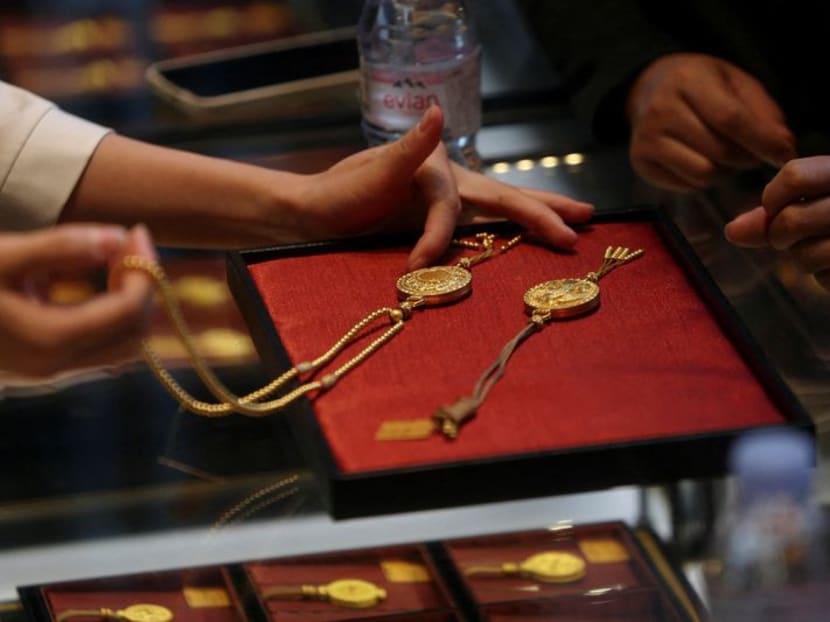
FILE PHOTO: A staff member attends to a customer at a Laopu Gold jewellery store in Beijing, China March 12, 2025. REUTERS/Florence Lo/File Photo
“No one can leave Laopu Gold empty-handed,” says one post on the Chinese photo-sharing app Xiaohongshu, under a shot of a user wearing a white T-shirt and gold-and-diamond-encrusted butterfly charm.
“Laopu’s dragon and phoenix pendant that was out of stock for a month finally landed in my hands,” says another, next to a chunky oval pendant with tassels and carved with the mythical creatures that symbolise harmony and auspiciousness in traditional Chinese culture.
There are hundreds of thousands of posts like this on the social media platform also known as RedNote, where Laopu — a homegrown purveyor of finely crafted gold jewellery that combines Chinese heritage with a modern edge — has surged in popularity in recent years. Its tongue-in-cheek nickname in China these days? The “Hermes of gold”.
The company has been an outlier in the Chinese luxury market, where appetite for splurging on expensive products by western brands is dwindling because of sluggish consumer confidence. Laopu, which literally translates as “old shop,” was started in 2009 by Xu Gaoming, 60, as a retail counterpart to his gold business Golden Treasury.
Xu, who started his career working for the Yueyang livestock and aquatic bureau in Hunan province before branching out into tourism investment and gold, jewellery and antiques trading, has been tapping into what is known as guochao. Translating as “national wave” — or a preference for products and brands that include or reference Chinese heritage elements — it is now a powerful force shaping Chinese consumer psychology.
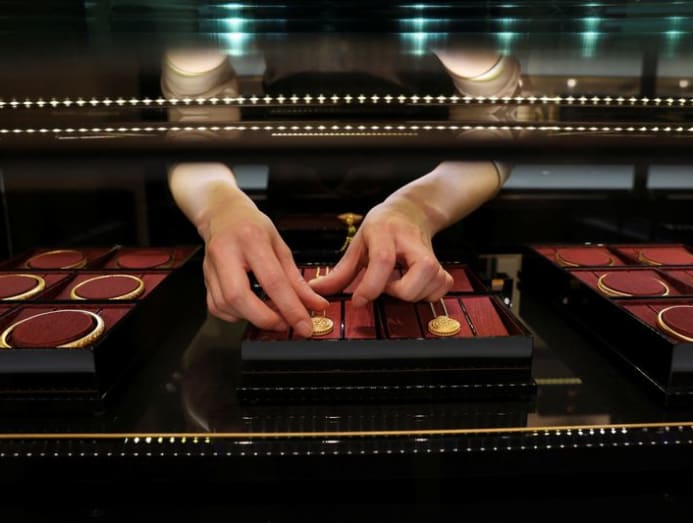
Laopu is targeting middle- and upper-class shoppers who see gold jewellery as a smart investment amid economic instability, but who have also developed a taste for branded items that focus on craftsmanship, design and storytelling. That approach appears to be working.
In 2024, Laopu’s revenue was up 167 per cent year-on-year to Rmb8.5 billion (US$1.1 million), more than six times what it was in 2021. Profits after tax were up 253 per cent year on year, to Rmb1.4 billion. The company, which declined interview requests from the Financial Times, said revenue reached Rmb12 billion in the first half of 2025, with net profits of Rmb2.2 billion.
Laopu uses a number of traditional techniques recognised as part of China’s cultural heritage, including gold, silver and filigree inlay. A simple gold band costs around Rmb5,080, but more complex pieces, such as the aforementioned dragon and phoenix pendant, can reach Rmb85,180. Unlike older traditional gold businesses such as Chow Tai Fook, Chow Sang Sang and Lao Feng Xiang, whose jewellery is mostly purchased for gifting and ceremonial occasions, Laopu has fashioned itself as a provider of meaningful pieces that can be worn anytime and anywhere.
“The product design borrows from Chinese culture, so the items themselves look traditional, but they are made to be worn at work, to parties — you wear [Laopu] every day, not only at weddings,” says Laura Yu, a luxury shopper, founder of lab-grown diamond brand Circe and former tech investor, who says many of her employees wear Laopu at work.
Repeatable, margin-rich jewellery designs have long been a cash cow for many western luxury brands. Laopu’s growth hasn’t been unnoticed abroad, with analysts and investors now questioning how much of a threat the brand could pose for established international players such as Cartier, Tiffany & Co and Van Cleef & Arpels.
“Laopu is a bit of a phenomenon because it’s neither a branded western brand nor a local commodity-driven retailer,” says Erwan Rambourg, global head of consumer and retail research at HSBC. “The interest of Laopu is that they are more about design than weight of gold. They are not purely commoditised, but they are local Chinese. It’s a hybrid proposition which seems to be gaining a lot of traction.”
The product design borrows from Chinese culture, so the items look traditional, but are made to be worn at work, to parties
Most domestic brands have struggled to break into the luxury sphere (with few exceptions such as Kering-owned Qeelin), but Laopu appears to be building trustworthy heritage credentials among both consumers and rivals alike.
Nicolas Bos, chief executive of Richemont — a group, like other western luxury conglomerates, that has reported double-digit sales declines in China — noted on a call this year that “Laopu Gold is a fantastic example of a new Chinese brand that’s very much rooted in Chinese culture. It has also integrated and understood some of the codes of international luxury and is developing a very, very unique and differentiated offer.”
To strengthen its luxury image, Laopu has carefully selected where to open its 41 stores, sticking to high-end malls including Beijing’s SKP Mall, Shanghai’s Plaza 66 and Singapore’s Marina Bay Sands, where it opened its first international boutique in June. It also provides loyal customers with VIP perks, including access to in-store private rooms with one-on-one services like its western counterparts.
And while Chinese traditional gold brands often price their products according to their weight and following the daily market fluctuations of gold prices (plus a small labour fee), Laopu operates with fixed prices that include a higher premium for its craftsmanship and design than others would charge. It also increases prices two to three times per year.
According to Adam Knight, co-founder of Chinese social commerce technology provider Yaso, a key part of Laopu’s success has been its marketing strategy on Xiaohongshu, where it has managed to build popularity among a number of key opinion leaders (KOLs) and key opinion customers (KOCs), avoiding more mass market techniques such as live-streaming. “It’s quite an elevated and mature digital strategy,” he says.
The brand’s fast growth has also attracted investor cash. Since its IPO last June, its share price has increased more than 14 times. Laopu is now included in the “three sisters”, a group of consumer brands that have hyper performed on the Hong Kong Stock Exchange post-float; these also include the toy company Pop Mart which creates Labubus and fast-food chain Mixue.
Some, however, are starting to question how sustainable Laopu’s growth is. On Xiaohongshu, alongside posts praising the brand’s gold jewellery, other netizens discuss the brand’s cash reserves, high investment in inventories and low gross profit margins (it hovers around 41 per cent compared to luxury standards of 60 to 80 per cent) with posts titled “Let’s talk about Laopu’s big risk”.
“In the past few months we have seen a slowdown in Laopu’s popularity,” says Veronica Wang, partner at OC&C Strategy Consultants in Hong Kong, who notes discounts and fewer queues outside stores. She adds that the market has also been flooded by cheaper alternatives featuring similar designs. “The price of gold is very transparent. What they have managed to do before was to charge a very high premium over the gold product that was justified by the craftsmanship. But if consumers can find similar products with much lower premium charge then some of them might shift away.”
And among some luxury consumers, Laopu is still seen as a lower-tier brand compared with international European luxury names. Yu, who favours brands such as The Row and Alaïa, says those who wear Laopu are “very typical urban middle-class” people. “Me and my friends, we are not clients of Laopu,” she says. “Its products are for young professionals or the middle upper class here in China. I don’t think it touches the clients of Chanel or Hermes. Laopu hurts the traditional gold brands more than the luxury brands.”
Annachiara Biondi © 2025 The Financial Times.
This article originally appeared in The Financial Times.